How Do Coriolis Mass Flowmeters Measure Liquid Density and Temperature?
Release time: 2026-11-03
Table of Contents
Monitoring liquid density and temperature helps industrial operators understand changes in fluid properties and maintain consistent process conditions. In chemical production, petroleum processing, food manufacturing, and energy applications, these parameters can provide useful information alongside flow rate data. A coriolis mass flowmeter combines multiple measurement functions in one instrument, allowing users to monitor mass flow, volume flow, density, and temperature.
Hefei Jingda Instrument Co., Ltd. is a modern instrumentation enterprise developed from the former Hefei Instrument Factory, which was founded in 1958. The company specializes in flowmeters, oil and gas measurement equipment, and flow measurement and control systems, serving industrial applications that require reliable measurement and process monitoring.

1. How Does a Coriolis Mass Flowmeter Measure Liquid Density?
A Coriolis mass flowmeter determines mass flow by measuring the response of vibrating tubes as fluid passes through them. The same measuring system can also provide density data by analyzing the vibration characteristics of the fluid-filled tubes.
The natural frequency of a vibrating tube depends partly on the mass of the tube and its contents. When the fluid density changes, the effective mass of the vibrating system changes, which affects its resonant frequency. The instrument’s electronic converter processes the sensor signals and uses the relationship between vibration frequency and fluid density to determine the density value.
This measurement method allows density to be monitored without relying solely on separate laboratory sampling. It is particularly useful when operators need to observe changes in liquid properties during a production process.
The JDMF series supports a density measurement range of 0.2–3.5 g/cm³, with a specified density measurement accuracy of ±0.003 g/cm³. This range covers a broad variety of liquid densities, although suitability for a particular medium should be confirmed against the actual operating conditions and product requirements.
2. How Is Liquid Temperature Measured?
Liquid temperature is another important parameter in industrial flow measurement. Temperature changes can affect fluid viscosity, density, and other physical properties, so temperature data helps operators interpret flow and density readings in the correct process context.
The JDMF series incorporates a temperature sensor in its detection element. The sensor measures temperature near the measuring tubes, and the converter processes the signal for display and output. This arrangement allows temperature information to be collected alongside the instrument’s other measurement data.
According to the product specifications, the integrated temperature measurement range is -40°C to +120°C. The stated temperature measurement accuracy is ±(1°C + indicated value × 0.5%).
These specifications help users assess whether the instrument is suitable for their operating temperature range. Before installation, the expected fluid temperature should be checked against the specified limits. Applications involving temperatures outside this range require an appropriately rated alternative.
It is also important to distinguish the temperature measured by the instrument from the temperature of the entire process system. The reading reflects the conditions at the measurement location, so installation position and thermal conditions may affect how representative it is of the wider process.
3. Why Measure Density and Temperature Together?
Density and temperature provide different but complementary information. Density describes mass per unit volume, while temperature indicates the thermal condition of the fluid. Monitoring both values can help operators understand whether changes in a process are associated with fluid properties or operating conditions.
For example, temperature changes can influence the density of many liquids. If an operator monitors flow without considering temperature, a change in the fluid’s physical properties may be harder to interpret. Having both readings available allows process data to be assessed more comprehensively.
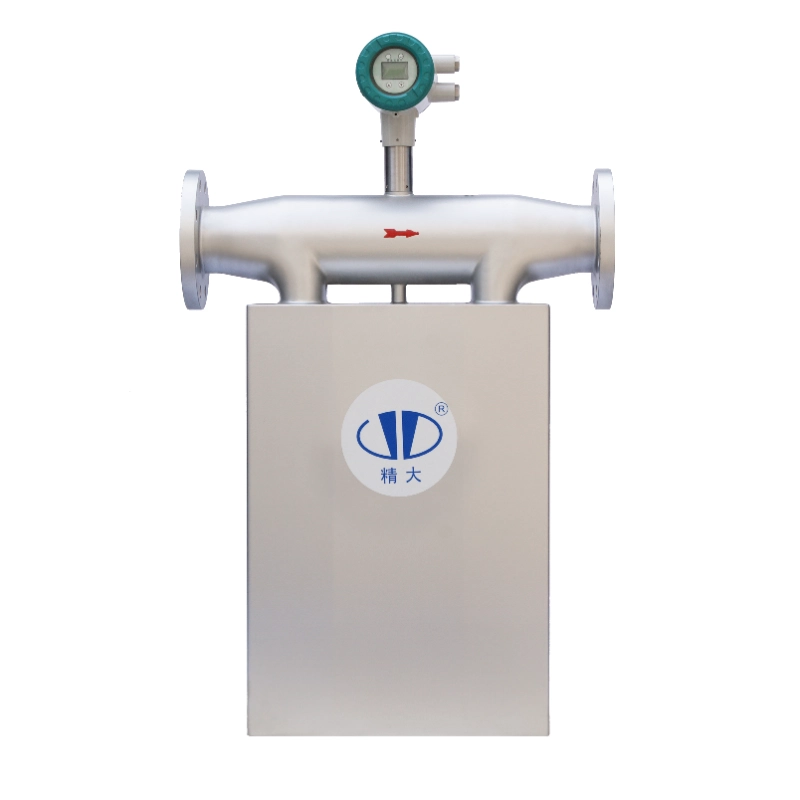
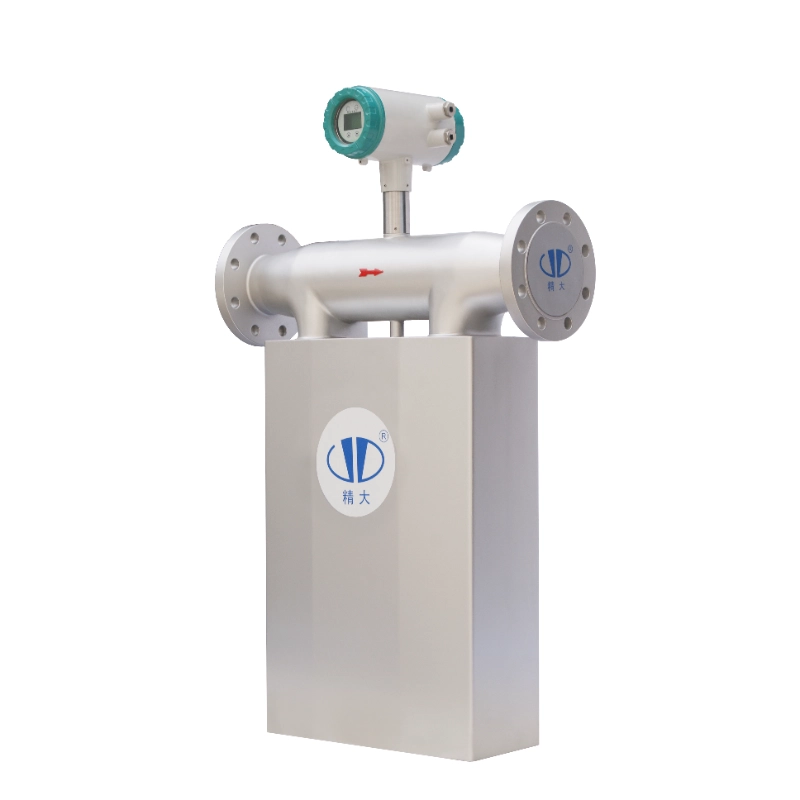
The JDMF series combines mass flow, volume flow, density, and temperature measurement in one instrument. Its LCD display can show instantaneous and cumulative flow values together with density and temperature parameters.
This integrated approach offers several practical advantages:
Provides multiple measurement values from one instrument.
Helps operators observe changes in liquid properties during production.
Reduces the need for separate instruments for each measured parameter where the integrated functions meet application requirements.
Supports process data analysis when flow, density, and temperature need to be evaluated together.
However, density and temperature measurements do not automatically identify a liquid’s chemical composition or guarantee product quality. Their value depends on the fluid being measured and how the data is used within the process.
4. Technical Specifications of the JDMF Series
When evaluating a coriolis mass flowmeter, engineers should consider density range, temperature range, measurement accuracy, pipe size, and operating pressure together. These parameters determine whether the instrument can accommodate the process requirements.
The main density and temperature specifications of the JDMF series are listed below.
| Parameter | Technical specification |
| Density measurement range | 0.2–3.5 g/cm³ |
| Density measurement accuracy | ±0.003 g/cm³ |
| Integrated temperature range | -40°C to +120°C |
| Temperature measurement accuracy | ±(1°C + indicated value × 0.5%) |
| Available nominal diameters | DN15–DN150 |
| LCD display | Mass flow, volume flow, density, and temperature |
| Current output | 4–20 mA |
| Frequency output | 0–10 kHz |
| Communication | RS485/Modbus or HART, depending on configuration |
The density and temperature ranges describe the instrument’s measurement capabilities, while the output options determine how the collected information can be accessed and transmitted. Users should confirm the exact communication and output configuration required for their installation.
The product’s stated maximum working pressure also varies by model: DN15–DN50 models are listed at up to 4 MPa, while DN80–DN150 models are listed at up to 2.5 MPa. These pressure limits should be considered separately from the temperature and density specifications when evaluating an application.
5. How Density and Temperature Data Support Industrial Processes
In industrial liquid flow measurement, density and temperature readings are most useful when they address a specific monitoring or control requirement. Different industries use these values in different ways, depending on the fluid and production process.
Chemical processing
Density monitoring can help identify changes in liquid properties during mixing, transfer, or formulation. Temperature readings provide additional context for interpreting those changes. Operators can compare both parameters with established process limits to identify conditions that may require investigation.
Petroleum and energy
Liquid properties can change with operating conditions and material composition. Density and temperature measurements provide useful information for monitoring fluid behavior during transfer and processing. The actual suitability of the instrument depends on the medium, pressure, temperature, and applicable measurement requirements.
Food and pharmaceutical production
Consistent liquid properties are important in many formulation and processing operations. Monitoring density and temperature can help operators observe process variations and review whether measured values remain within defined operating limits. Application-specific hygiene, material compatibility, and regulatory requirements should be assessed separately.
Environmental and utility systems
Liquid measurement systems may need to track changing operating conditions over extended periods. Combining flow data with density and temperature readings can provide a broader picture of the measured medium and support routine process monitoring.
Across these applications, measurement data should be interpreted in relation to the process rather than treated as an independent indication of product quality.
6. Transmitting Measurement Data for Process Monitoring
Collecting density and temperature readings is only part of the measurement task. In automated facilities, the information may also need to be transferred to control rooms, data acquisition equipment, or compatible process control systems.
The JDMF series provides a 4–20 mA current output, a frequency output from 0 Hz to 10 kHz, and RS485 communication using Modbus or HART, depending on the configuration. Its converter processes signals from the detection element and supports local display, output, storage, remote transmission, and adjustment of instrument parameters.
These functions allow measurement information to be incorporated into wider monitoring arrangements where the selected interface is compatible with the receiving equipment. For example, an analog output can provide a measurement signal to a compatible control system, while digital communication can support data exchange and remote parameter access.
The available specifications do not establish that every measurement parameter is transmitted through every output simultaneously. Users should therefore confirm the signal mapping, communication protocol, and required data fields before integrating the instrument into an existing automation system.
7. Installation Factors That Affect Measurement Reliability
Correct installation is important for obtaining representative density and temperature readings. The JDMF documentation describes horizontal and vertical pipeline arrangements, with mounting orientation selected according to the fluid and application.
Before commissioning, engineers should check the pipeline layout, flow direction, mounting orientation, and operating conditions against the manufacturer’s installation instructions. The meter should also be operated within its specified fluid temperature, ambient temperature, pressure, and electrical supply limits.
The converter’s specified supply voltage is (24 ± 10%) V, with machine power consumption below 15 W. The stated ambient temperature range for the integrated configuration is -25°C to +50°C, and the specified ambient humidity is no more than 90% RH without condensation.
These limits are separate from the fluid temperature range. Checking both sets of conditions helps ensure that the instrument and its electronic components are used within their specified operating environment.
Routine checks of electrical connections, signal transmission, and measurement stability can also help identify installation or operating issues. If density or temperature readings change unexpectedly, operators should consider actual process changes as well as sensor condition, installation, and configuration before drawing conclusions.
Conclusion
Coriolis mass flowmeters provide a practical way to monitor liquid density and temperature alongside mass flow and volume flow. By analyzing the vibration characteristics of the measuring tubes and processing temperature sensor signals, the instrument can provide several useful measurement values from one integrated system.
With a specified density range of 0.2–3.5 g/cm³, density accuracy of ±0.003 g/cm³, and an integrated temperature range of -40°C to +120°C, the JDMF series offers defined measurement capabilities for a range of industrial applications. The appropriate model should be selected according to the fluid properties, operating conditions, required accuracy, and system integration needs.
Drawing on its instrumentation manufacturing history dating back to 1958, Hefei Jingda Instrument Co., Ltd. provides flow measurement and control equipment for industrial users. Reviewing the product specifications and installation requirements before deployment helps ensure that density and temperature data can be used effectively in process monitoring.
Frequently Asked Questions
1. What is the density measurement range of the JDMF Coriolis mass flowmeter?
The JDMF series has a specified density measurement range of 0.2–3.5 g/cm³, with a density measurement accuracy of ±0.003 g/cm³. These specifications help users evaluate whether the instrument is suitable for measuring the density of their process liquids.
2. What is the operating temperature range of the JDMF mass flowmeter?
The integrated configuration supports a fluid temperature measurement range of -40°C to +120°C, with a specified temperature measurement accuracy of ±(1°C + indicated value × 0.5%). Users should also check the ambient temperature limits and other operating conditions before installation.
3. Can a Coriolis mass flowmeter measure density and temperature simultaneously?
Yes. The JDMF series can measure mass flow, volume flow, density, and temperature. These parameters are available through the instrument’s display and supported output functions, subject to the selected configuration. This integrated capability helps operators monitor flow and fluid properties using one instrument.
4. How can density and temperature measurements help industrial process monitoring?
Density measurements can help identify changes in fluid properties, while temperature readings provide information about thermal conditions that may influence those properties. When evaluated alongside flow data, these measurements can support process monitoring, material consistency checks, and investigation of unusual operating conditions.
5. What communication options are available for the JDMF series?
The JDMF series supports 4–20 mA current output, 0–10 kHz frequency output, and RS485 communication using Modbus or HART, depending on the configuration. Before connecting the instrument to a PLC or other control system, users should confirm interface compatibility and which measurement values are available through the selected output.